




Introduction
The Medical Technology (MedTech) industry has attracted significant activity in the past decade. Estimated at $6.3 billion in 2013, it is growing at 10-12% per annum. However, government estimates indicate that there is potential for 8-fold growth in the next 10 years. How will the potential be realized? And what role will innovation play in supporting this growth?
Challenges in Indian Healthcare
The acute shortage of healthcare services in India - be it doctors, nurses or hospital beds - creates a unique set of challenges - two in particular.
First, this situation gives rise to the need for technologies that "deskill" healthcare delivery - those that standardize and simplify activities, so that they can be performed by "non-experts". This frees up the time of doctors and specialized nursing staff to focus on value-added, patient-centric activities.
Second, the shortage of hospital infrastructure creates the need for healthcare delivery that can extend to the community and home - reducing burden on hospitals and patients alike.
The following case studies illustrate how solutions were developed in response to these challenges.
Case Study I: ICU Data, On-Demand
ICU care requires coordinated effort between the treating specialist and medical officers/ nurses present at the patient's bedside. Often, in low-resource settings, such as Tier III and IV towns, the specialist under whose care the patient is admitted is not available for extended periods within the ICU, since they provide services to multiple hospitals and nursing homes.
In such a setting, the specialist examines patients, conducts laboratory investigations, and analyzes a patient's vital signs to arrive at a diagnosis and a treatment plan.
Under the supervision of a medical officer (MO), a nurse administers this treatment plan, provides bedside care to the patient, and routinely monitors vital signs and basic blood-based parameters. In case the nurse observes any deviations, s/he informs the MO and the specialist, who amend the treatment plan suitably.
Though the measurement of a patient's vital signs and blood-based parameters has been automated, there is need for cost-effective, intuitive and scalable solutions that share this data simultaneously with off-site specialists, and MOs and nurses within the ICU.
Based on this understanding, Lattice Innovations has designed & developed a multi-para ICU patient monitor that integrates measurement and simultaneous data sharing within a single system. It also has value-added features - intuitive data display, and built-in alerts that assist in detecting deviations.
Such a system eliminates the need for specialists to repeatedly call up the ICU to get an update on the status of their patient.
The Medical Technology (MedTech) industry has attracted significant activity in the past decade. Estimated at $6.3 billion in 2013, it is growing at 10-12% per annum. However, government estimates indicate that there is potential for 8-fold growth in the next 10 years. How will the potential be realized? And what role will innovation play in supporting this growth?
Challenges in Indian Healthcare
The acute shortage of healthcare services in India - be it doctors, nurses or hospital beds - creates a unique set of challenges - two in particular.
First, this situation gives rise to the need for technologies that "deskill" healthcare delivery - those that standardize and simplify activities, so that they can be performed by "non-experts". This frees up the time of doctors and specialized nursing staff to focus on value-added, patient-centric activities.
Second, the shortage of hospital infrastructure creates the need for healthcare delivery that can extend to the community and home - reducing burden on hospitals and patients alike.
The following case studies illustrate how solutions were developed in response to these challenges.
Case Study I: ICU Data, On-Demand
ICU care requires coordinated effort between the treating specialist and medical officers/ nurses present at the patient's bedside. Often, in low-resource settings, such as Tier III and IV towns, the specialist under whose care the patient is admitted is not available for extended periods within the ICU, since they provide services to multiple hospitals and nursing homes.
In such a setting, the specialist examines patients, conducts laboratory investigations, and analyzes a patient's vital signs to arrive at a diagnosis and a treatment plan.
Under the supervision of a medical officer (MO), a nurse administers this treatment plan, provides bedside care to the patient, and routinely monitors vital signs and basic blood-based parameters. In case the nurse observes any deviations, s/he informs the MO and the specialist, who amend the treatment plan suitably.
Though the measurement of a patient's vital signs and blood-based parameters has been automated, there is need for cost-effective, intuitive and scalable solutions that share this data simultaneously with off-site specialists, and MOs and nurses within the ICU.
Based on this understanding, Lattice Innovations has designed & developed a multi-para ICU patient monitor that integrates measurement and simultaneous data sharing within a single system. It also has value-added features - intuitive data display, and built-in alerts that assist in detecting deviations.
Such a system eliminates the need for specialists to repeatedly call up the ICU to get an update on the status of their patient.
Articles Archive
Subscribe to Newsletter
What the hack
Medical Technology Innovation - an Entrepreneur's Perspective
A Leader should influence the team to ensure that right ethical decisions are made and should work towards ensuring such a culture is maintained across the organization
Only a disruptive approach to problem solving in the challenging healthcare space can yield results. Jugaadathon 2015 gave us tremendous insights on what it means to crowdsource solutions for healthcare
Live Twitter Feed
Video
GE Leadership

Mandeep Singh Kumar
Director-Commercial
GE Healthcare India & South Asia
Copyright © 2015 GE Healthcare

Each patient monitoring system has 2 key components:
Case Study I: Images
- Measurement Device: measures parameters, alerts users with audio/ visual alarms, transmits data to Android tablet (via Bluetooth), and transmits data to remote-access cloud server (via Wi-Fi).
- Android tablet: provides patient registration and blood test data entry fields, displays trend and point values, shows alarm logs, and provides Skype calling via Wi-Fi.
Case Study I: Images
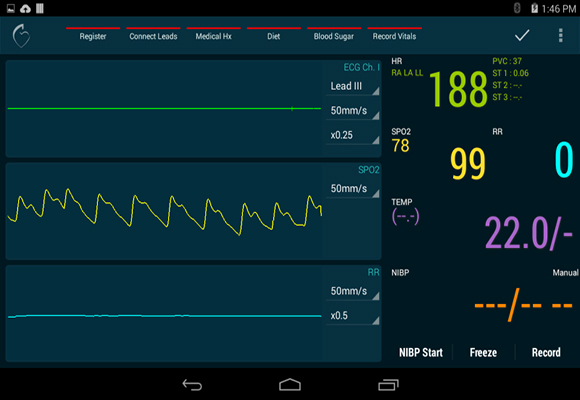
Figure 1: Monitoring Screen on Android Tablet. The interface includes patient registration and bed assignment.

Figure 2, 3: Front and Side view of the patient monitor. In the front view, the LCD display of the device is visible. In the side view, probe sockets are visible. The tablet has a separate stand, with the option to mount them on a lockable industrial that can be fixed to the patient's bedside.
Case Study II: Cardiac Risk Assessment for the Community
In 2005, Cardiovascular Disease (CVD) caused 30% of all deaths in the Indian subcontinent, and is projected to rise to 43% by 2021. In India alone, from 2005 to 2015, CVD, stroke and diabetes are estimated to cause cumulative income loss of US $233.6 billion.
In Cardiology, primary & secondary care facilities for early diagnosis, appropriate care, ethical treatment methods, and cure have not grown to address disease problem early & adequately, whereas tertiary care services dominated by procedure-driven care have grown exponentially. The result is detection at late stage and treatment at a very high cost, often unaffordable to large sections of society – both in terms of money and mortality.
Again, to avail diagnosis and detection services, patients have to go to established hospitals, losing his/her earning time – which many in the society cannot afford and hence neglect at initial stages.
Hence, there is a pressing need for affordable solutions that entire communities can access regularly, for timely check-up and diagnosis of CVD. Early identification of those at risk enables effective treatment at a low cost.
This need was identified based on inputs from Cardiologists at the Amrita Institute of Medical Sciences (AIMS), Kochi. Over the past 16 years, AIMS has built a stellar reputation as an institutions that delivers high quality, ethical, tertiary care, at affordable costs. It has won and retained the trust of the communities it serves, for which FICCI felicitated it with the National Healthcare Excellence Award, 2013.
Based on this understanding, AIMS planned to leverage its community support to create an innovative model of healthcare delivery - a cardiology outreach network that provides community-based care, and appropriately escalates at-risk patients to the main hospital.
To enable this, Lattice Innovations developed a cardiac screening kiosk that can be operated by a technician. This kiosk delivers a risk assessment report within 6 minutes, and is designed to be portable, easy to use, and modular in its design.
The backbone of the system is a risk assessment algorithm, that draws data from physiological signs, the patient's medical history, diet and lifestyle, to generate a clinically-validated risk score.
In 2005, Cardiovascular Disease (CVD) caused 30% of all deaths in the Indian subcontinent, and is projected to rise to 43% by 2021. In India alone, from 2005 to 2015, CVD, stroke and diabetes are estimated to cause cumulative income loss of US $233.6 billion.
In Cardiology, primary & secondary care facilities for early diagnosis, appropriate care, ethical treatment methods, and cure have not grown to address disease problem early & adequately, whereas tertiary care services dominated by procedure-driven care have grown exponentially. The result is detection at late stage and treatment at a very high cost, often unaffordable to large sections of society – both in terms of money and mortality.
Again, to avail diagnosis and detection services, patients have to go to established hospitals, losing his/her earning time – which many in the society cannot afford and hence neglect at initial stages.
Hence, there is a pressing need for affordable solutions that entire communities can access regularly, for timely check-up and diagnosis of CVD. Early identification of those at risk enables effective treatment at a low cost.
This need was identified based on inputs from Cardiologists at the Amrita Institute of Medical Sciences (AIMS), Kochi. Over the past 16 years, AIMS has built a stellar reputation as an institutions that delivers high quality, ethical, tertiary care, at affordable costs. It has won and retained the trust of the communities it serves, for which FICCI felicitated it with the National Healthcare Excellence Award, 2013.
Based on this understanding, AIMS planned to leverage its community support to create an innovative model of healthcare delivery - a cardiology outreach network that provides community-based care, and appropriately escalates at-risk patients to the main hospital.
To enable this, Lattice Innovations developed a cardiac screening kiosk that can be operated by a technician. This kiosk delivers a risk assessment report within 6 minutes, and is designed to be portable, easy to use, and modular in its design.
The backbone of the system is a risk assessment algorithm, that draws data from physiological signs, the patient's medical history, diet and lifestyle, to generate a clinically-validated risk score.

Figure 3: Parameters measured by the Cardiac Risk Assessment Kiosk. All the instruments required for measurement fit into one portable case.

Figure 4, 5: The Kiosk includes a compact tent and branding material. As seen above, the community outreach program is titled "Just a Drop" - since a single drop of blood is all that needs to be drawn. On the right, Dr. Jaideep Menon, Head, Preventive Cardiology, AIMS is seen as willing volunteer during the commissioning of the system.
Innovation as a Business Model
The above case studies are based on the work of Lattice Innovations, a medical technology design & development based out of Kolkata and Delhi.
The three co-founders, Sahil Mehta, Chayan Chatterjee, and Soura Bhattacharyya, came together to start Lattice in September 2014, with a shared vision of creating a design factory for medical devices - a one-stop shop that converts ideas into readily usable products & solutions. They bootstrapped the venture, and reached cash-flow breakeven by May 2015.
Soura, as the CEO, leads the need finding and client engagement process, using his past experiences in clinical development, research and product design to identify and articulate challenges faces by healthcare providers. Prior to Lattice, he headed Technology Development and HR for Global Healthcare, a semi-urban hospital chain. He holds an MBA (High Honors) from Harvard Business School and a B.Tech from IIT Kharagpur.
Sahil Mehta, as the CTO, designs & builds hardware solutions. He specializes in biomedical engineering, and has developed 14 functional device prototypes in the past 5 years, across industry and academia, for orthopedics, diabetes and cardiovascular applications. Sahil holds a M.Engg in Biomedical Engineering from Cornell and a BS in Biomedical Engineering from the University of Utah.
Chayan Chatterjee, as the COO, leads software development and product delivery. Chayan started his career with ITC Limited, a consumer goods conglomerate in India, in manufacturing and engineering. He subsequently held roles in sales operations, product management & product development in medical devices. Chayan holds an MBA from the Wharton School of Business, and a dual degree M.Tech/ B.Tech from IIT Bombay.
Closing Thoughts
This is an exciting time for medical technology innovators - India has the need for new solutions that are "made in India, made for India".
MedTech’s growth has been paralleled by a much more visible and explosive growth in consumer electronics and software. Products that lie at the intersection of these two fields - such as wearable and portable devices that measure steps walked, heart rate and ECG - are now widely available.
However, medicine is a specialized, knowledge-intensive domain, where it is difficult for innovators to draw from everyday experiences to design products and solutions. They require input from users - such as doctors and nurses - who traditionally have had an arms' length separation from technologists and engineers.
Second, since medical technology innovation has a direct impact on lives, the adoption of new technology is tempered by the need for clinical evidence that proves that new solutions do not increase risk to patients, while delivering added value. This too, requires participation from specialists within the medical community.
Finally, there is wide variability in operating processes and methods in healthcare delivery. The technology needs of a Government-run primary healthcare center are very different from that of a private, tertiary care hospital - even when treating the same disease. Thus, an understanding of the environment within which a technology will be used is as critical as clarity about the purpose it serves.
Hence, there is need for user-centered design in MedTech - so that those who utilize these technologies are partners in the design & development process. Innovations in diagnostics, monitoring & sensing systems, data analytics and decision support have the potential to unlock value in the short term.
When supported by an ecosystem of clinicians, nurses, paramedics, hospital administrators, patients/ their families, there is significant scope to develop impactful technologies that change the paradigm of healthcare delivery - in India and the world.
The above case studies are based on the work of Lattice Innovations, a medical technology design & development based out of Kolkata and Delhi.
The three co-founders, Sahil Mehta, Chayan Chatterjee, and Soura Bhattacharyya, came together to start Lattice in September 2014, with a shared vision of creating a design factory for medical devices - a one-stop shop that converts ideas into readily usable products & solutions. They bootstrapped the venture, and reached cash-flow breakeven by May 2015.
Soura, as the CEO, leads the need finding and client engagement process, using his past experiences in clinical development, research and product design to identify and articulate challenges faces by healthcare providers. Prior to Lattice, he headed Technology Development and HR for Global Healthcare, a semi-urban hospital chain. He holds an MBA (High Honors) from Harvard Business School and a B.Tech from IIT Kharagpur.
Sahil Mehta, as the CTO, designs & builds hardware solutions. He specializes in biomedical engineering, and has developed 14 functional device prototypes in the past 5 years, across industry and academia, for orthopedics, diabetes and cardiovascular applications. Sahil holds a M.Engg in Biomedical Engineering from Cornell and a BS in Biomedical Engineering from the University of Utah.
Chayan Chatterjee, as the COO, leads software development and product delivery. Chayan started his career with ITC Limited, a consumer goods conglomerate in India, in manufacturing and engineering. He subsequently held roles in sales operations, product management & product development in medical devices. Chayan holds an MBA from the Wharton School of Business, and a dual degree M.Tech/ B.Tech from IIT Bombay.
Closing Thoughts
This is an exciting time for medical technology innovators - India has the need for new solutions that are "made in India, made for India".
MedTech’s growth has been paralleled by a much more visible and explosive growth in consumer electronics and software. Products that lie at the intersection of these two fields - such as wearable and portable devices that measure steps walked, heart rate and ECG - are now widely available.
However, medicine is a specialized, knowledge-intensive domain, where it is difficult for innovators to draw from everyday experiences to design products and solutions. They require input from users - such as doctors and nurses - who traditionally have had an arms' length separation from technologists and engineers.
Second, since medical technology innovation has a direct impact on lives, the adoption of new technology is tempered by the need for clinical evidence that proves that new solutions do not increase risk to patients, while delivering added value. This too, requires participation from specialists within the medical community.
Finally, there is wide variability in operating processes and methods in healthcare delivery. The technology needs of a Government-run primary healthcare center are very different from that of a private, tertiary care hospital - even when treating the same disease. Thus, an understanding of the environment within which a technology will be used is as critical as clarity about the purpose it serves.
Hence, there is need for user-centered design in MedTech - so that those who utilize these technologies are partners in the design & development process. Innovations in diagnostics, monitoring & sensing systems, data analytics and decision support have the potential to unlock value in the short term.
When supported by an ecosystem of clinicians, nurses, paramedics, hospital administrators, patients/ their families, there is significant scope to develop impactful technologies that change the paradigm of healthcare delivery - in India and the world.
Let the word spread: